

Overview
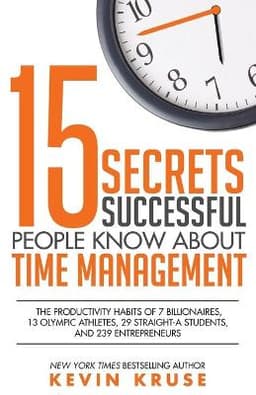
Kevin Kruse’s 15 Secrets Successful People Know About Time Management is built around a simple premise:
Time is your most valuable and scarcest resource.
You cannot earn more of it.
You cannot borrow it.
You cannot buy it back once it’s gone.
There are only 1,440 minutes in a day. Successful people treat those minutes like capital. They invest them deliberately. They protect them. They refuse to waste them on low-return activity.
In three sentences:
- Change your relationship with time - value it above all else.
- Design your day around your highest-impact work, especially in your most productive hours.
- If something matters, schedule it in your calendar. Do not leave it on a vague to-do list.
This book is less about clever hacks and more about seriousness.
Time as the Ultimate Constraint
Kruse makes a point that is easy to nod at and hard to internalize:
You can’t spend time and go earn more of it. You can’t buy it, rent it, or borrow it.
Money compounds. Skills compound. Networks compound. Time does not.
When you say yes to something, you are saying no to something else. Always.
“The difference between successful people and very successful people is that very successful people say ‘no’ to almost everything.”
~ Warren Buffett
That line sits at the center of the book.
If you are not deliberate with your time, you will end up advancing someone else’s agenda. Meetings. Emails. Requests. Other people’s emergencies.
As Kruse puts it:
If you aren’t busy working on your own goals, you’ll be working to achieve somebody else’s goals.
That feels blunt, but accurate.
Motion vs Progress
A theme running through the book is the difference between activity and impact.
Do not confuse motion and progress. A rocking horse keeps moving but does not make any progress.
It is possible to fill a day completely and still avoid your most important work.
Highly productive people ask a sharper question:
Will this activity help me reach my goal?
If the answer is no, they reconsider.
There is also a useful distinction between efficiency and effectiveness.
Efficiency is doing the thing right. Effectiveness is doing the right thing.
You can be highly efficient at the wrong tasks.
Identify the Trunk, Not the Branches
Kruse emphasizes identifying your Most Important Tasks (MITs).
Think of your goal as a tree. The trunk is the fundamental lever. The branches are secondary.
If you want to become a capable investor, the trunk might be learning to read financial statements. Not reading every investment book in sight. Not endlessly scrolling commentary. Learn the core skill first.
The question becomes:
What is the bottleneck to my progress right now?
Then attack that.
Everything else is secondary.
Scrap the To-Do List. Use a Calendar.
One of the more practical shifts Kruse recommends is replacing to-do lists with calendar scheduling.
Highly successful people do not leave important work floating in intention. They assign it a time slot.
If you value health, schedule your workout as a recurring appointment.
If you value writing, block out 7:00 to 9:00 a.m. for it.
If you value strategic thinking, give it a protected window.
Break the day into 15 or 30 minute blocks if needed. Schedule your MITs early.
As the day progresses, uncertainty increases. Interruptions accumulate. Energy declines.
If something truly matters, it belongs in your calendar.
Ritualize the Morning
Kruse’s research across high performers reveals a pattern.
Most wake early.
Most hydrate.
Most move their bodies.
Many meditate, journal, or read.
More importantly, they protect their first hours.
One of the saddest mistakes in time management, he argues, is spending your two most productive hours on low-cognitive tasks like social media or email.
Our cognitive capacity declines throughout the day. You will not think at 4 p.m. the way you think at 8 a.m.
Even if you do not consider yourself a morning person, the principle still holds: identify your peak hours and guard them fiercely.
High-leverage work first. Administrative work later.
Energy, Not Just Time
A useful nuance in the book is that productivity is about energy and focus, not just clock time.
Research suggests we operate in roughly 90-minute cycles of focus and fatigue. Pushing through with caffeine and willpower is possible, but unsustainable.
In one study cited, high-productivity workers tended to work intensely for about 52 minutes and then take a 17-minute break.
The lesson is not to mimic those exact numbers. It is to respect attention cycles.
When you notice yourself rereading the same sentence repeatedly, it may not be a discipline problem. It may be a fatigue problem.
Build in breaks. Walk. Hydrate. Reset.
Touch It Once
Kruse also highlights a “touch it once” mentality.
When you encounter something, decide what to do with it immediately if possible.
If it will take five minutes or less, do it.
If not, schedule it.
Do not repeatedly handle the same email or decision. That burns mental bandwidth.
The goal is to reduce open loops.
Buy Back Your Time
One of the more controversial but practical ideas in the book is leveraging money to buy time.
If it costs £10 to have someone cut your lawn and your time is worth more than that, outsource it.
The goal is not laziness. It is leverage.
Free up hours to work on higher-impact activities, or simply to rest and renew.
Time is the only resource that does not replenish. Protect it accordingly.
The Stop-Doing List
We often think in terms of adding habits.
Kruse suggests also creating a stop-doing list.
Watch less TV.
Mute notifications.
Prep meals in bulk instead of cooking inefficiently every day.
Buy birthday cards in batches.
Set clear meeting end times in advance.
Small eliminations compound.
Don’t spend a dollar’s worth of time on a ten-cent decision.
That line lingers. How often do we do exactly that?
Discipline Over Intelligence
One quote in the book captures its spirit:
If I was building a character in a business video game and I had ten character points to distribute, I’d put three of them into intelligence and seven of them into self-discipline.
We tend to overvalue cleverness and undervalue consistency.
Most people know what they should do. They struggle to do it consistently, especially when it is inconvenient.
Kruse reminds us that we underestimate how hard it is to be our best self in the present moment. Planning is easy. Execution, repeatedly, is rare.
Final Thoughts
The message of 15 Secrets Successful People Know About Time Management is not complicated.
Take time seriously.
Schedule what matters.
Protect your peak hours.
Say no often.
Focus on the trunk, not the branches.
If you did not spend your week working on your most important goal, what did you spend it on?
That question is uncomfortable.
But it is clarifying.