

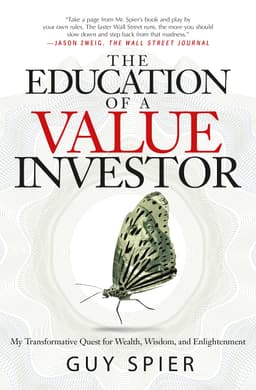
Overview
Guy Spier’s The Education of a Value Investor is less a technical manual and more a personal reckoning.
There are no complicated valuation tricks here. No secret formulas. The book is about temperament, ego, and the quiet ways intelligent people undermine themselves long before the market does anything dramatic.
Spier describes his evolution from a prestige-driven, comparison-focused young investor into someone who deliberately redesigned his life around better decision-making. The thread running through the story is simple but demanding. You are not trying to become smarter than the market. You are trying to become less foolish than yourself.
That shift sounds minor. In practice, it forces you to look at everything differently.
Environment Shapes the Investor
One of the most powerful ideas in the book is environmental design.
We like to think that we change our environment, but the truth is that it changes us.
Spier realised that much of his poor decision-making was not caused by a lack of intelligence. It was caused by proximity - to noise, to status games, to short-term incentives.
He began restructuring his physical and social environment with the same seriousness he once applied to analysing balance sheets.
He split his office into two separate spaces. One room was a quiet library for reading and thinking. The other was a work room for email, Bloomberg, and execution. No screens in the thinking room. No ambient market chatter. The physical act of walking between rooms became a small but meaningful commitment device.
When I first read that, I recognised how casually I treat my own workspace. Screens open. Tabs multiplying. Prices blinking in the background. It is difficult to think clearly in that environment, even if you convince yourself you can.
It sounds trivial until you notice how often investing failure begins with impulse.
Ed Seykota described that temptation perfectly:
Having a quote machine is like having a slot machine on your desk - you end up feeding it all day long. I get my price data after the close each day.
Spier’s solution was not heroic willpower. It was structure. He reduced the number of decisions he needed to get right in the first place.
Checklists and Circuit Breakers
Spier developed a set of rules to protect himself from predictable psychological errors. Some of them appear strict at first glance. Do not check stock prices constantly. Do not talk to management. Do not discuss current investments. Gather research in a fixed order. Never trade while the market is open. If a stock falls after purchase, do not sell for two years.
The individual rules matter less than the logic behind them.
Money activates primitive instincts. Urgency narrows attention. Early information leaves a strong imprint. Social interaction introduces commitment bias before you have finished thinking.
Spier understood that managers are often excellent salespeople. So are brokers. So is financial media. Even well-meaning peers can distort your reasoning simply by speaking too soon.
Don’t ask the barber whether you need a haircut.
I have felt how quickly a falling price can create the sensation that something must be done. Spier’s rules acknowledge that action and wisdom are not the same thing. By creating distance between stimulus and response, he gave himself a chance to think before reacting. That pause is often where good judgment lives.
Cloning Structure, Not Trades
Spier is open about imitation.
He studied Warren Buffett and Mohnish Pabrai closely. He visited Omaha. He looked beyond stock selections and paid attention to habits, friendships, reading lists, and daily routines.
The objective was not to become Buffett. It was to internalise the patterns that support long-term clarity.
You can learn a lot from other people. In fact, I think if you learn reasonably well from other people, you don't have to get any new ideas or do much on your own. You can just apply the best of what you see.
Spier refers to this as cloning, but not in the superficial sense of copying trades. He paid attention to who they spent time with, how they structured their days, and what they deliberately avoided.
He also spoke about making friends with the eminent dead - studying figures from history who demonstrated discipline and resilience under pressure.
There is nothing mystical about this. Your peer group compounds. So do your models. Spend enough time around thoughtful people and your standards rise. Spend enough time in reactive environments and your thinking narrows.
Reading as Lifelong Training
Spier emphasises reading in a structured way.
Accounting is the language of business. If you cannot read annual reports comfortably, you are working with incomplete information. Corporate filings come first. Press releases second. Books and articles third. Equity research last.
The order protects independence. It prevents you from inheriting someone else’s conclusion before forming your own.
He also found depth outside finance - in psychology, biology, and behavioural science. Finance textbooks explain ratios. They do not always explain why intelligent people make avoidable mistakes.
Know the big ideas in the big disciplines and use them routinely - all of them, not just a few.
Investing is numerical, but it is also human. Numbers become misleading when you ignore the behaviour that produces them.
Compounding Goodwill
One of the warmer themes in the book is generosity.
Spier made a deliberate effort to help others without calculating immediate benefit. Introductions. Advice. Encouragement. Over time, this built trust and strengthened his circle.
It also reduced envy. Comparison is easy in investing. There is always someone with better returns or a more impressive network. That mindset distorts incentives and quietly corrodes judgment.
I recognised parts of that tendency in myself. It is easy to measure progress against others. It is harder to focus patiently on your own process.
Compounding goodwill is not abstract idealism. Trust attracts higher quality relationships. Higher quality relationships improve information flow and opportunity set. The effects are subtle, but over years they matter.
Small Habits, Slow Change
Spier’s transformation was not sudden. It was incremental.
Where he sat. What he read first. When he checked prices. Who he spoke to before making a decision. None of these actions look decisive in isolation. Over time, they alter the baseline from which decisions are made.
From the outside, value investing can look like patience and spreadsheets. In practice, it is a long sequence of small behavioural choices that either strengthen or weaken you gradually.
Ignore small leaks long enough and the outcome is rarely dramatic, but it is predictable.
Who Should Read It
This book works at several levels.
A beginner will find it grounding. It makes investing feel human rather than intimidating.
An experienced investor may recognise their own blind spots and refine their structure.
More than anything, the book clarifies what the real opponent is.
The fault, dear investor, is not in our stars - and not in our stocks - but in ourselves.
Spier’s education was not about discovering hidden financial secrets. It was about identifying the predictable ways he was likely to go wrong and then designing a life that made those mistakes less likely.
Final Thoughts
What stayed with me most is how modest the adjustments are.
A quieter room. Fewer reactive conversations. A longer pause before acting. A more deliberate choice of company.
None of it feels dramatic in the moment. There are no breakthrough formulas here. But over years, those structural decisions accumulate. And the cumulative effect can exceed any clever insight or faster model.
That, to me, is the real education in this book.
In His Own Words
If you would rather hear Guy Spier discuss these ideas directly, this conversation is a good companion to the book.
Guy Spier discussing process, temperament, and building an investment life deliberately.