

Overview
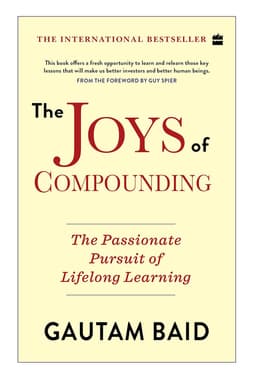
Gautam Baid’s The Joys of Compounding is a book about investing, but it is really a book about becoming the sort of person for whom compounding works. It sits as a nice companion to The Education of a Value Investor.
It is structured like a manual. There are models, frameworks, reading lists, and clear instructions. But underneath the structure sits a quieter message: returns compound only when character does.
Baid writes from the perspective of someone who has studied Buffett and Munger carefully, but who understands that copying stock ideas is the least interesting part of the exercise. The deeper work is internal. Curiosity, patience, humility, and emotional control are not decorative traits in investing. They are functional.
One line from the book captures that spirit:
Curiosity is antifragile; magnified by attempts to satisfy it.
Compounding, in Baid’s framing, begins with curiosity. And it continues with discipline.
Compounding Is Broader Than Capital
Most people hear “compounding” and think of money. Baid expands the definition.
Knowledge compounds.
Reputation compounds.
Trust compounds.
Habits compound.
Capital is only one expression of the same underlying principle: small, repeated actions accumulating beyond what intuition expects.
This is why the book spends as much time on reading, health, relationships, and intellectual honesty as it does on valuation. If you erode the base, the financial layer cannot sustain itself.
Charlie Munger’s formulation sits comfortably here:
Know the big ideas in the big disciplines and use them routinely — all of them, not just a few.
Baid treats investing as an applied exercise in multidisciplinary thinking. Accounting matters. Psychology matters. Biology matters. Incentives matter. The edge is rarely in a spreadsheet formula. It is in how you connect what you already know.
Process Over Ego
A recurring theme in the book is that investing failure often begins with ego.
When you need to be right, you stop learning. When you identify with your ideas, you resist evidence that contradicts them. Over time, this turns what should be a probabilistic process into a personal contest.
Baid argues for something simpler and harder: focus on process and let outcomes take care of themselves.
There is a quiet alignment here with the broader value investing tradition. As Larry Hite put it:
I have two basic rules about winning in trading as well as in life: (1) If you don't bet, you can't win. (2) If you lose all your chips, you can't bet.
Survival is a precondition for compounding. That means position sizing, humility about uncertainty, and an acceptance that avoiding ruin is more important than chasing brilliance.
You can feel the discipline in Baid’s writing. He is less interested in forecasting the next quarter and more interested in building a repeatable decision architecture that can operate across decades.
Reading as Competitive Advantage
One of the more practical sections of the book is its emphasis on reading — deeply, broadly, and repeatedly.
Baid echoes a pattern seen in many great investors: read primary sources first. Annual reports. Shareholder letters. Original texts. Only then layer in interpretation.
Charlie Munger’s blunt observation appears again as both warning and encouragement:
In my whole life, I have known no wise people who didn’t read all the time—none, zero.
The mechanism is straightforward. Wide reading builds mental models. Mental models allow you to recognise patterns. Pattern recognition reduces unforced errors.
But there is also something more subtle. Reading disciplines the mind. It slows you down. It exposes you to the long arc of history, which in turn makes short-term market noise feel less urgent.
In a business where impatience is expensive, that is not a trivial edge.
Incentives, Moats, and Owner Mindset
On the technical side, Baid is firmly in the tradition of quality-focused value investing.
He emphasises durable competitive advantages, capable and ethical management, strong balance sheets, and reinvestment opportunities at high incremental returns. But even here, the analysis is framed through incentives and behaviour.
Who controls the capital allocation decisions?
What are they rewarded for?
Do they think like owners?
The quote that captures this mindset is simple:
Buy businesses that you understand, run by people that you like and that are priced attractively.
Baid encourages concentrated portfolios when understanding is deep and risk is asymmetrical. He is not advocating recklessness. He is arguing that conviction should reflect knowledge, not optimism.
Risk, in this framework, is less about price volatility and more about ignorance.
Risk is proportional to ignorance more than it is proportional to any other factor.
When you read Baid closely, you see that much of the work is about shrinking ignorance.
Character as a Financial Asset
What differentiates The Joys of Compounding from a standard investing manual is its sustained attention to character.
Integrity, delayed gratification, and long-term orientation are treated as economic variables. A person who cannot control envy will chase what others have. A person who cannot tolerate boredom will overtrade. A person who cannot admit error will compound mistakes.
There is a line in the quote bank that aligns almost perfectly with Baid’s emphasis:
Environment trumps intellect.
Your environment determines your habits. Your habits determine your behaviour. Your behaviour determines your results.
Baid’s advice, read carefully, is less about optimising a model and more about designing a life in which good decisions are the default. That may mean limiting information intake, choosing peers carefully, or avoiding certain situations entirely.
It is a sober view. You are not trying to outwit the market each day. You are trying to avoid undermining yourself over time.
The Long View
Perhaps the most important constraint Baid emphasises is time.
Compounding requires duration. Duration requires emotional stability. Emotional stability requires perspective.
Markets cycle. Strategies fall in and out of favour. What persists is the underlying arithmetic of incremental improvement.
Howard Marks captures the mindset that supports this:
Rule number one: most things will prove to be cyclical.
Rule number two: some of the greatest opportunities for gain and loss come when other people forget rule number one.
To benefit from cycles, you must survive them. To survive them, you must understand them. To understand them, you must detach from them emotionally.
Baid’s writing repeatedly circles back to this idea. The investor who enjoys the process, who treats learning as its own reward, is better positioned to endure periods when results lag.
That enjoyment is not naive optimism. It is a stabilising force.
Who Should Read It
This book rewards the serious student.
A beginner will find it structured and practical, with clear guidance on what to study and how to think. An experienced investor may find it a useful recalibration — a reminder that edge comes from discipline more often than from novelty.
The deeper value of the book is that it connects investing with life design. It argues, gently but persistently, that financial freedom is not just about accumulating capital but about cultivating the traits that allow capital to grow without distorting your judgment.
Compounding, in Baid’s telling, is not a trick of mathematics. It is a reflection of character expressed consistently over time.
Final Thoughts
What stayed with me most is the breadth of the concept.
Compounding is not a spreadsheet function. It is a way of operating.
Read widely.
Think independently.
Guard your temperament.
Protect your downside.
Repeat.
None of these actions feel dramatic in isolation. Over years, they rarely are - but they accumulate quietly in the background.
The joy, as Baid frames it, is not in watching a number rise on a screen. It is in knowing that the structure you have built - intellectually and personally - can continue to compound long after the excitement fades.
That is a sturdier foundation than any single investment idea.